Services

Aligned across the Waterline. End to end.

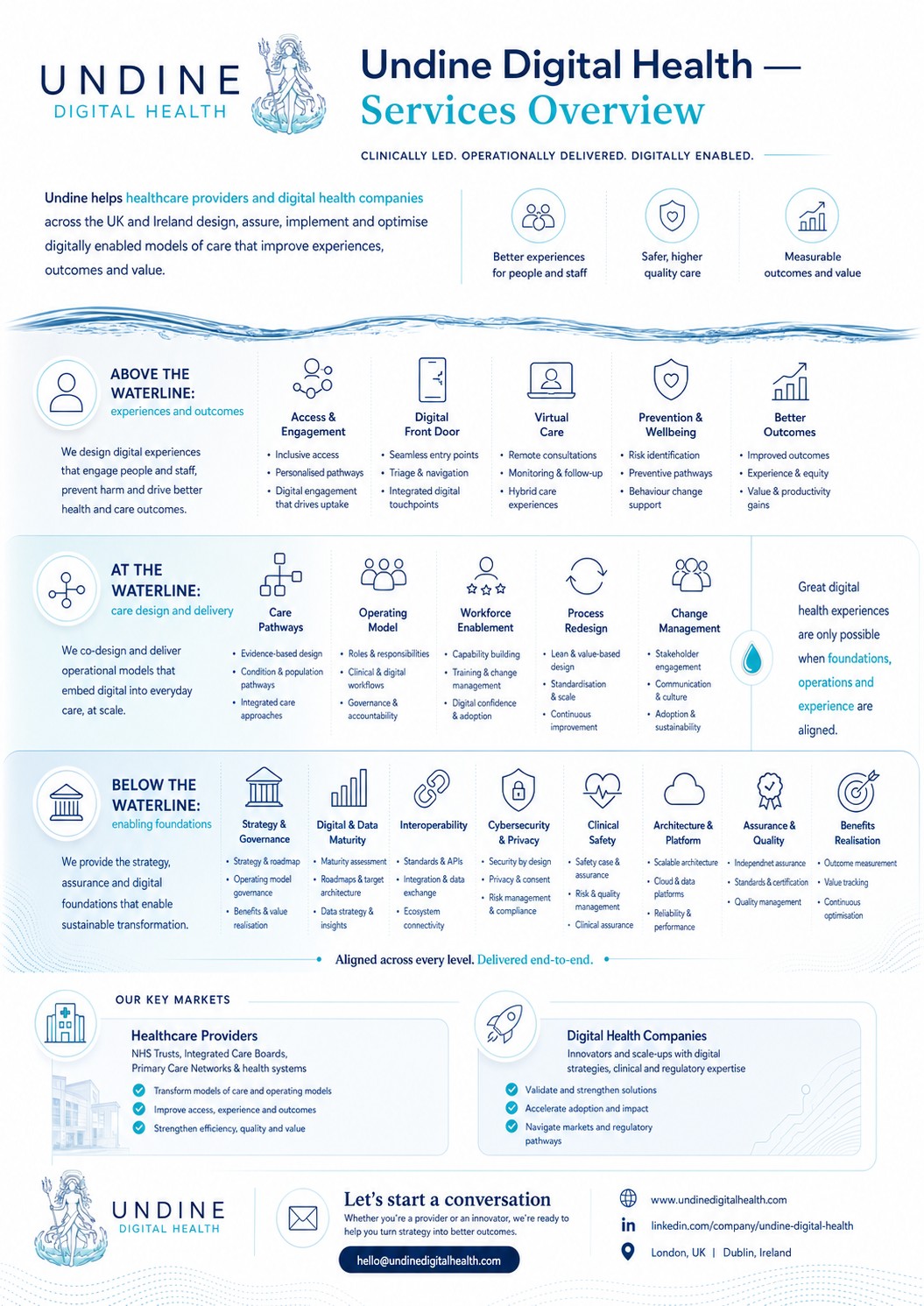
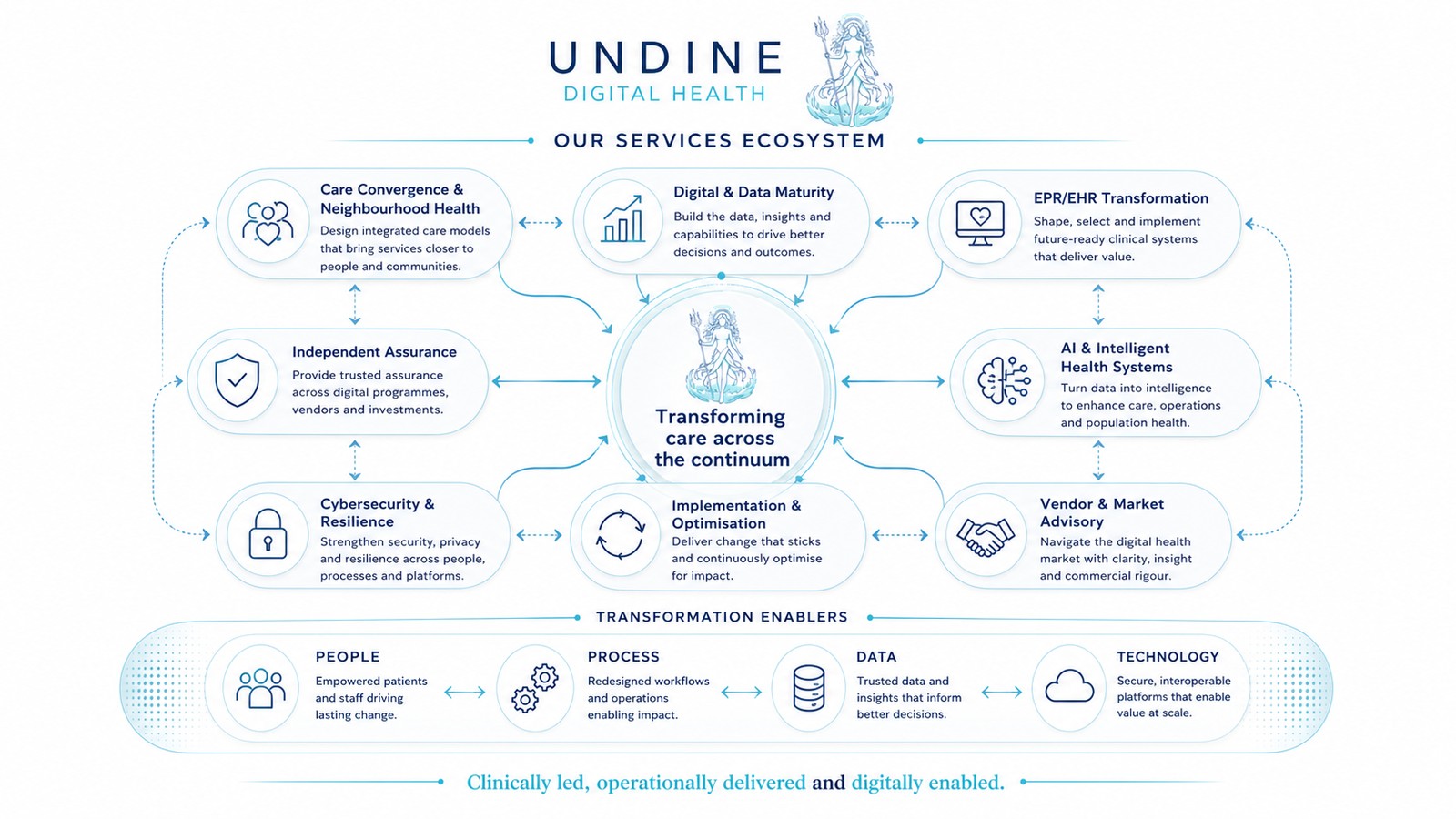
Our services map directly to the three layers of the Undine Waterline Model. We engage across all of them — or focus where the gap is — but we don't pretend to optimise one in isolation.

Below the Waterline At the Waterline Above the Waterline Workshops
Layer 01 · Foundations

Below the Waterline

Strategy, architecture, data and assurance. These are the conditions that determine whether transformation is sustainable — or whether it stalls before adoption begins. Most programmes underinvest here and pay for it later.

Strategy & Technology Roadmapping

We help organisations move from "analogue" to "digital" by establishing the Foundations of Digital Maturity — not by procuring more software.

  • Infrastructure audit:  Identifying accumulated technical debt and mandating realistic investment upfront, before clinical tools are deployed.
  • National alignment:  Visioning tied to NHS 10 Year Plan, Frontline Digitisation, What Good Looks Like, and Sláintecare in Ireland.
  • Sustainable foundations:  Resilient networks, secure data environments, and HIMSS EMRAM/INFRAM benchmarked pathways to measurable maturity.

Data Maturity & Interoperability

FHIR, HL7, Open Data — connecting the systems that should already be talking. We design the data layer your clinical and operational teams need, not the one the vendor sold you.

  • FHIR/HL7 strategy:  Mapping the interoperability roadmap from current-state messaging to event-driven, standards-based exchange.
  • Federated Data Platform integration:  Neutral governance for FDP local instances, aligned with the NHS 2028 single patient record target.
  • Shared care records:  Multi-organisational governance, consent management, and clinical workflows for cross-boundary care.

Architecture, Cyber & Resilience

A scalable platform that doesn't fall over — and doesn't fall to attack. Architecture decisions taken under our governance are vendor-aware, not vendor-led.

  • Solution architecture:  Cloud, on-premise, and hybrid patterns appropriate for each domain — not a default to whatever the vendor recommends.
  • Cybersecurity:  Cyber Essentials Plus, NIS2 alignment, privileged access, patching discipline, and incident readiness.
  • Business continuity:  Incident response plans that involve clinical care units — not just IT. When systems fail, patients don't wait.

Safety, Assurance & Benefits

Clinical safety (DCB 0129/0160), independent programme assurance, and benefits realisation tracking — making the case that what was promised has been delivered.

  • Clinical safety:  A nominated Clinical Safety Officer approves hazards and safety case reports throughout the programme — risks tracked in a living document, not buried in a sign-off package.
  • Independent Programme Assurance:  Bridging the governance gap between IT, finance, and the clinical floor — particularly during EPR delivery.
  • Benefits realisation:  TCO/ROI validation, capability ROI tracking, and measurable value frameworks tied to the original business case.
Layer 02 · Operations

At the Waterline

How care is actually designed and delivered. Operating models, care pathways, workforce capability and adaptive change — the layer where strategy meets the clinical floor.

Care Pathways & Operating Model

Designed journeys for patients and staff — mapped, instrumented, and embedded in the technology layer. Pathways aren't slides; they are how work actually flows.

  • Pathway mapping:  Current-state and future-state visualisation across primary, acute, mental health and community settings.
  • Operating model design:  Roles, flows, governance and accountability for the post-transformation organisation.
  • Configuration:  EPR (Epic, Cerner/Oracle, MEDITECH) and best-of-breed clinical systems — tailored to the pathway, not to vendor defaults.

Workforce Enablement & Adaptive Change

The "human element" is the most frequent cause of programme failure. We work shoulder-to-shoulder with frontline teams — not through a top-down change management consultancy lens.

  • Workforce literacy:  Upskilling staff in the design, maintenance and continuous improvement of their digital tools.
  • User-centred design:  National and regional UCD research programmes ensuring tools are accessible, intuitive, and reduce administrative burden.
  • Managed off-boarding:  We embed capability into your team so you are not dependent on external consultants indefinitely.

Process Redesign & Change Management

Lean, safe, and sustainable. We don't just install new software on top of old workflows — we redesign the workflow so the new tools deliver the value they were procured to deliver.

  • Process redesign:  Lean principles applied to clinical and operational workflows, with safety and throughput as joint success criteria.
  • Change management:  Sustained behaviour change through clinical-led adoption, peer networks, and post-deployment optimisation tails of 5–10 years.
  • Programme recovery:  Critical Friend Audits and KPI realignment for stalled or failing programmes — rapid diagnosis, clear recommendations, no politics.
Layer 03 · Experience

Above the Waterline

What patients and staff actually experience when the system works. Access, engagement, virtual care, prevention, and the outcomes that justify the investment.

Digital Front Door & Access

The first point of contact — whether through a patient portal, a clinic, or a navigation pathway. Designed for the user, not for the procurement framework.

  • Patient access design:  Booking, triage, signposting and navigation experiences that reduce missed appointments and unnecessary contact.
  • Engagement strategy:  Personalised communication aligned to clinical need and patient preference, with measurement of effectiveness.
  • Accessibility & inclusion:  Core20PLUS5-aligned designs that narrow access gaps rather than widening them.

Virtual Care & Prevention

Care delivered beyond the hospital walls — in homes, clinics, and community settings. Anchored in data, designed for clinical safety, sized for actual demand.

  • Virtual ward design:  Operating model, clinical pathway, and technology stack for safe and scalable virtual care.
  • Remote monitoring:  Long-term condition pathways using data from patient-generated and wearable sources.
  • Predictive prevention:  Population-health analytics that move care from reactive to proactive — risk stratification and wellbeing interventions.

AI Readiness & Innovation

We de-risk your AI investment through our AI Readiness Quick-Start: Ethical & Viability Audit — before you commit capital.

Book the AI Readiness Quick-Start
  • Data fidelity audit:  Auditing source data (e.g. EPR) to ensure it is clean, standardised, and unbiased before it trains anything.
  • Ethical governance:  Aligning AI adoption with MHRA principles of fairness, accountability, and clinical safety.
  • Predictive modelling:  Use-case validation, model risk assessment, and pathway redesign to capture the benefits AI promises.
Workshops

Two pragmatic ways to start.

Short, structured engagements designed to give you clarity, not a sales pitch. Both can be combined and both feed naturally into a broader engagement — or stand alone.

Waterline Diagnostic

A structured one-week assessment of your strengths and gaps across all three Waterline layers, with a written report identifying priorities and quick wins.

1 week · written report · executive briefing

AI Readiness Quick-Start

A half-day structured workshop assessing your data fidelity, governance, and viability — with a written report identifying the shortest path to your first safe AI deployment.

Half-day · written report · ethical & viability audit